
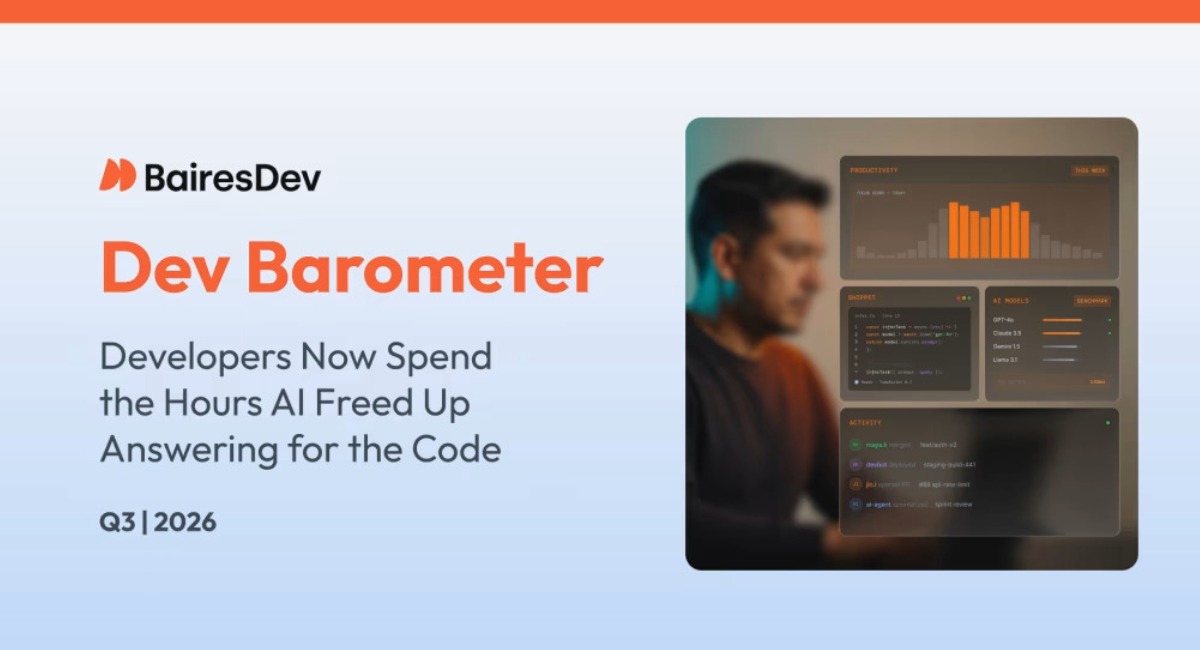
MOUNTAIN VIEW, Calif., September 26, 2026: BairesDev’s Dev Barometer shows Indian developers now save 14 hours per week on average by coding with AI and spend that time a layer above the code: reviewing AI output, debugging it, and upskilling. AI tool fluency, human skills, and system design are driving 2026 developer pay raises.
BairesDev®, one of the largest bootstrapped technology companies in the world, released the Q3 2026 edition of its Dev Barometer, marking one year of quarterly tracking of how AI is reshaping software work. The findings draw on 705 developers across 60+ countries, including 81 from India, and, for the first time, 41 global enterprise CTOs. In a year, the role has shifted from writing code to overseeing it.
This edition’s findings show that Indian developers now save 14 hours per week on average by coding with AI. But that time isn’t being freed up. They’re reinvesting it a layer above the code.
One year of AI on the job (Q3 2025 vs. Q3 2026 edition):
Coding hours saved increased. Indian developers report saving 14 hours a week by coding with AI, up from 10 hours a year ago.
AI cut the typing. The thinking got harder. Only 22% of Indian developers now spend more than half their week writing new code from scratch. The rest of the week has moved up the stack: 73% spend more time reviewing AI-generated code and 69% spend more time debugging AI-introduced problems than a year ago, work that requires judgment about what to keep, fix, or reject.
The skills and pay shift. AI tool fluency (47%), human skills (29%), and system architecture (24%) drive developer pay raises.
Adoption and fulfillment both climbed. 79% say AI writes over a quarter of their code, up from 43%, while 90% find their role more fulfilling, up from 81%.
“Indian developers report saving 14 hours a week on coding with AI, up from 10 hours last year. Not one of those hours came back. Reviewing check-ins. Fixing what the model broke. Learning next quarter’s tool. A year ago we read the first ten hours as capacity, and we got that wrong. The time mostly moved up the stack, into work that takes more judgment than the coding it replaced,” said Darren Shimkus, CEO of BairesDev.
Developers Are Now the Accountability Layer for AI-Generated Code
In Q1 2026, 66% of Indian developers already reported that accountability for AI-generated code sat with them personally. What’s new in Q3 2026 is that global CTOs are confirming it: 78% have increased spending on code review, QA, and validation to support AI-generated work, and only 9% of Indian developers say the ship decision has been entirely delegated to AI without their input.
The scrutiny tracks with how fast AI investment is growing overall. Gartner’s May 2026 forecast projected worldwide AI spending will reach $2.59 trillion in 2026, up 47% year over year. BairesDev’s data suggests a growing share of that spending is now being redirected toward review and validation, not adoption alone.
The Skills Getting Developers Raises in 2026 Are Not the Skills CTOs Are Funding
Among Indian developers who got a raise this year, AI tool fluency ranked first as the driver (47%), followed by human skills like communication, mentorship, and cross-functional collaboration (29%) and system design and architecture (24%), ahead of the other technical AI specializations tested. And only 1 in 4 global CTOs are actively investing in human skills, concentrating budget instead on AI tool fluency and data infrastructure.
One year of Dev Barometer data shows AI has scaled fast inside software teams, and by developers’ own account has made the work more fulfilling. It has also quietly rewritten what the work is. The job hasn’t gone away because of AI. It now sits a layer above the code: reviewing what AI produces, applying it to problems only a human understands, and staying fluent in tools that change every few months. That is a different kind of engineer, and a more valuable one.
About the Dev Barometer Survey
The Dev Barometer is BairesDev’s quarterly global survey of software developers. Since 2025, the initiative has collected responses from 5,200+ engineers across 75+ countries. Prior editions have been discussed at World Economic Forum programming in Davos (2026) and covered by outlets including VentureBeat. The Q3 2026 report gathered quantitative responses from 705 software developers across 60+ countries and 41 enterprise CTOs across Fortune 500 and mid-market organizations. For more information visit https://bairesdev.com/research
About The Author